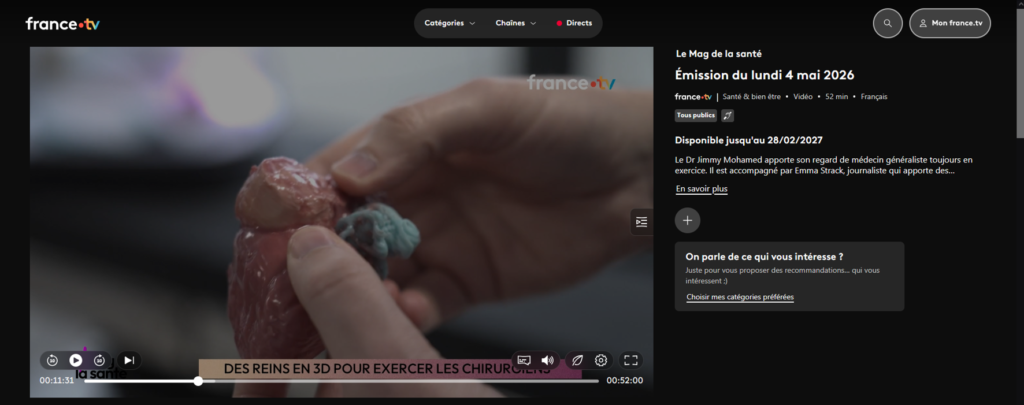
The RHU Digital Urology 3D project, led by Professor JC Bernhard of the Bordeaux University Hospital CHU, aims to train surgeons in micro-robot-assisted partial nephrectomy. The training models shown in this film were created through a collaborative effort between teams from the Centre de Recherche Paul Pascal (development of the ink formulations used for printing the models), the Laboratory of the Future (LOF) (3D printing by extrusion in a carrier gel), and the IUT TechnoShop (setup of a printing production platform).
The models are obtained through an initial step of emulsifying water in the liquid silicone matrix. Controlling the formulation then allows the aggregation of water droplets within this matrix, creating a network of interconnected micrometric water channels in the final polymerized material. These micro-water channels mimic the network of microcapillaries found in human kidney tissue. When surgeons incise the material, the model bleeds in a manner similar to that of a human kidney during surgery. The presence of water within these materials also allows for the modulation of the silicone’s mechanical properties, closely approximating those of human tissue. The ink formulation used to print these models is the subject of a CNRS patent application.