


What if the light from a standard microscope were enough to organize matter?
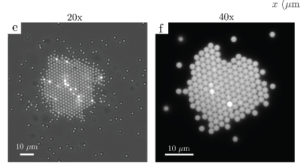
Light has long been used to trap and organize microscopic particles… but most approaches rely on focused lasers and complex optical setups. A team at the University of Bordeaux (CRPP), led by Cristian Villalobos-Concha and Laura Alvarez, now shows that much simpler illumination can do the job: the incoherent light from a standard microscope.
The principle is simple: LED light illuminates a thin metallic layer deposited on the substrate, locally generating a temperature gradient. This gradient produces thermo-osmotic flows that transport particles toward the illuminated region. The colloids accumulate and spontaneously organize into large two-dimensional crystals, without depletants or chemical modification. When the light is switched off, the structures dissolve again within seconds.
By simply changing the light intensity, the researchers can control the collective state of the system: at high intensity, particles form compact crystals, while at lower intensity they remain in a more dynamic flock-like state. These assemblies can also be transported by moving the heated region relative to the sample.
This work turns a conventional microscope into a simple and reconfigurable optothermal platform for assembling and manipulating matter far from equilibrium. The approach is particularly promising for colloids, vesicles and synthetic cells, without the need for dedicated laser infrastructure.
Contact:
Te: 05 56 84 30 27