


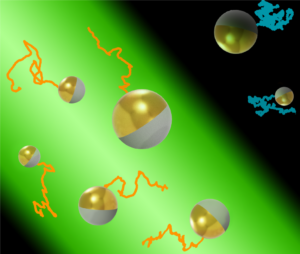
 Active nanoparticles are attracting growing interest in medicine and biotechnology, particularly for applications such as targeted drug delivery and nanosurgery. Yet their use faces a major challenge: at the nanometer scale, particle motion is constantly disrupted by thermal fluctuations—known as Brownian motion—which makes controlled, directed propulsion inherently difficult.
To address this challenge, researchers at the CNRS investigated Janus nanoparticles a few tens of nanometers in diameter, composed of gold and silica. When illuminated with a green laser beam, these nanoparticles can move directionally through a liquid, despite the random disturbances caused by Brownian motion. By tracking individual particle trajectories using dark-field microscopy, the researchers have shown that their propulsion can be activated and tuned by light, with an efficiency comparable to the random forces driving Brownian motion.
This advance demonstrates that it is possible to actively control the motion of nanoparticles at a scale where thermal forces dominate, paving the way for more precise and less invasive biomedical applications. This minimal system—both reversible and non-toxic—could become a key tool for manipulating matter at the nanoscale and for studying active dynamics in complex environments.
Reference:
Light-Activated Self-Thermophoretic Janus Nanopropellers, H. Truong, C. Moretti, L. Buisson, B. Abecassis, E. Grelet, Nanoscale 18, 5221-5230 (2026).
Contact :
Eric Grelet
Centre de Recherche Paul-Pascal, UMR 5031
C.N.R.S. – Université de Bordeaux, 115 Avenue Albert Schweitzer, 33600 Pessac, France
Phone: +33 5 56 84 56 13