


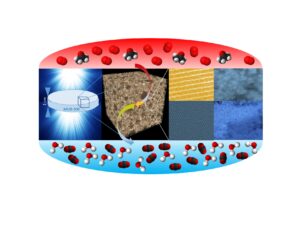
 Nowadays heterogeneous photocatalysis is involving only bi-dimensional processes. These action modes being exclusively surfacic (2D) are indeed totally pragmatic as photons’ penetration depth into solid state materials does not exceed the hundreds of micrometers at best…In such configuration films are appearing as the unambiguous candidates of choice! Claiming for a “bulky behavior” regarding contact photo-catalysis is appearing thereby totally counter-intuitive at a glance. And yet, Aquitaine teams (ISM, IPREM and CRPP) let the light shine in multi-scale porous materials (the MUB) while employing low consumption LED as a light source. Pioneers in this domain, they demonstrated for the first time that a balance between light adsorption-diffusion is a sine qua none condition towards reaching advanced VOCs photo-degradation in bulk, opening the pass toward onboard miniaturized air-remediation processing (cars, plains, trains). This finding may find additional extensions towards photovoltaic applications (DSSCs), CO2 photo-reduction and beyond. This work is just published at the RSC (Chem. Comm.)1.
Acknowledgments. Authors wish to thanks the “Université de Bordeaux”, the “Région Aquitaine” and the GPR PPM “Post Petroleum Materials”
Contact : Professeur Rénal Backov, CRPP, renal.backov@crpp.cnrs.fr
1 Photocatalysis in Volume using Anatase-TiO2-SiO2 Monoliths toward Efficient VOC Photodegradation E. Layan, G. Clermont, I. Ly, F. Nallet, R.A.L. Vallée, T. Pigot, R. Backov , M. Le Bechec, and T. Toupance. Chem. Comm., RSC, 2025, (DOI: 10.1039/D5CC02552D).