


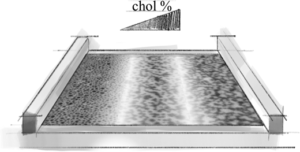
 In a collaboration between the University of Bordeaux (CRPP) and Heinrich Heine University Düsseldorf, a team led by Pantelis Mpourazanis, Laura Alvarez and Ivo Buttinoni investigated how cholesterol modifies the structure and mechanical properties of lipid layers similar to those found in pulmonary surfactants. These interfaces are mainly composed here of DPPC, a phospholipid that is a major component of lung surfactants. When a DPPC layer is compressed, the lipids transition from a disordered and fluid state to a more condensed and organized one. Adding cholesterol strongly changes this behaviour: the condensed domains become increasingly elongated and eventually form an interconnected network, while the viscosity of the interface decreases dramatically. By combining fluorescence microscopy, Langmuir compression and interfacial rheology, the researchers show that cholesterol does more than simply fluidize the interface: it also reorganizes its microscopic structure. This structural change strongly reduces viscous dissipation and produces a relatively more elastic response. This work therefore establishes a direct connection between lipid composition, domain organization and interfacial mechanics, providing new insight into how membrane composition controls its response to mechanical stresses. A nice connection between soft matter, interfacial physics and biomimetic membranes!
Contact:
Tel: 05 56 84 30 27